

Vizhinjam: a deep-water automated port redefining international port standards
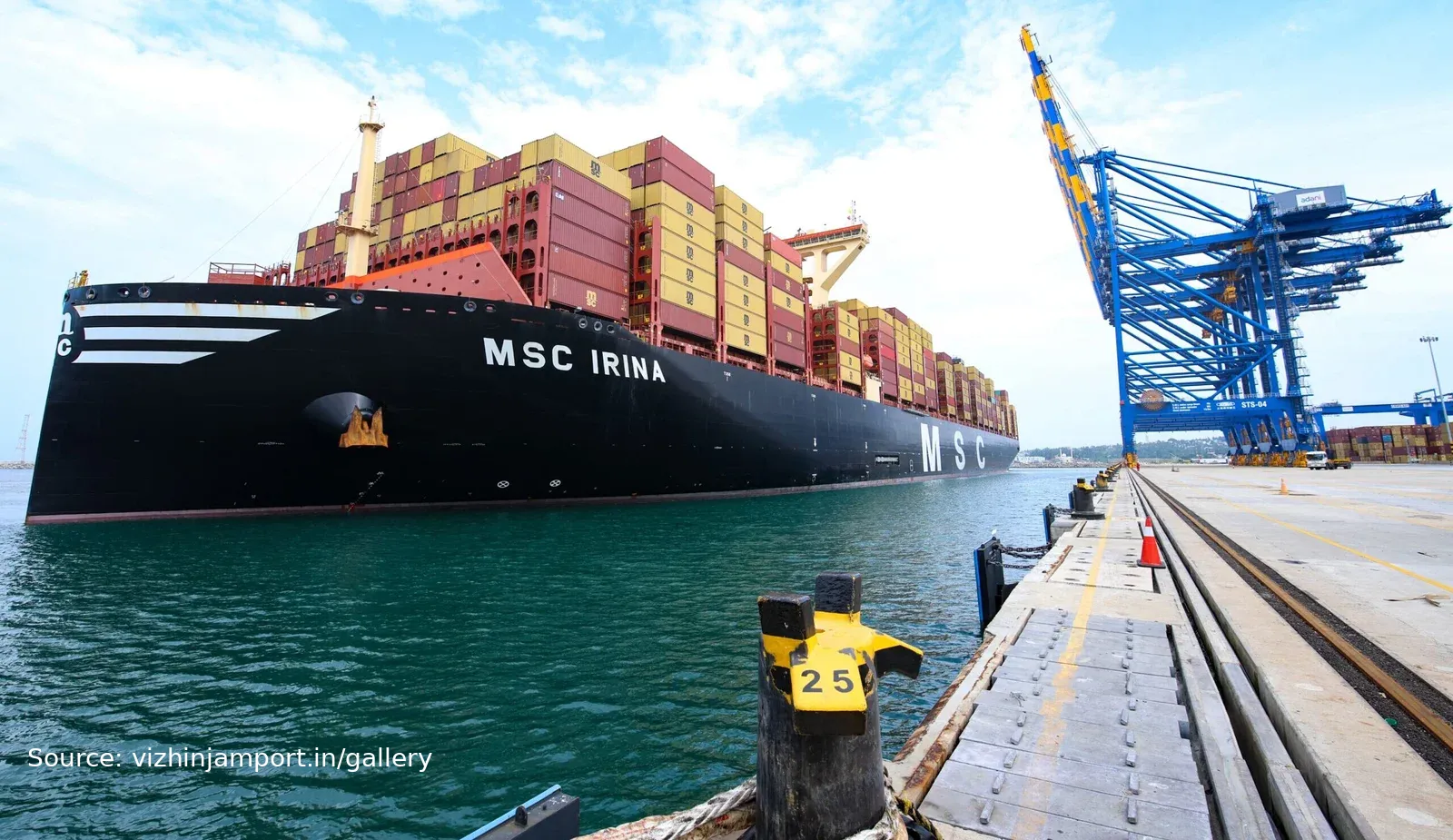
The Port of Vizhinjam, located on the south-west coast of India in the State of Kerala, stands as one of the most significant port developments of the decade.
Designed from inception as a deep-water automated port, it addresses a dual challenge now central to modern port engineering: accommodating the world’s largest container vessels while delivering high standards of operational efficiency, safety and long-term durability.
Beyond the infrastructure itself, Vizhinjam represents a reference project for port authorities, engineering consultants and international lenders. It illustrates the transition towards highly integrated, mechanised and data-driven port systems, designed to minimise long-term maintenance constraints.
At CREOSEA, such projects are analysed from a resolutely operational perspective, combining maritime design, environmental constraints, underwater inspection, asset maintenance, aids to navigation and on-site supervision.
Context, definition and technical challenges
A deep-water port aligned with global shipping routes
Vizhinjam is first and foremost a natural deep-water port, with water depths exceeding 18–20 metres close to shore. This characteristic significantly limits maintenance dredging requirements, a critical factor in lifecycle cost assessments for modern ports.
In a context where container vessels exceeding 20,000 TEU dominate East–West trade routes, the ability to accommodate such ships without nautical constraints has become a major strategic advantage.
A strategic location on international maritime corridors
Located in close proximity to the East–West shipping corridor linking Asia, the Middle East and Europe, Vizhinjam is designed as an international transhipment hub, reducing regional reliance on congested Asian ports.
For port engineers, this implies:
- High-capacity, productivity-driven terminal design.
- Maximum reliability of maritime structures.
- Uninterrupted 24/7 operational continuity.
Automation: scope and engineering implications
A deep-water automated port relies on:
- Automated ship-to-shore cranes.
- Autonomous guided vehicles (AGVs).
- Integrated terminal operating systems (TOS).
- Continuous infrastructure monitoring.
Such automation significantly increases requirements in terms of design quality, structural tolerances and preventive maintenance strategies.
H2 #2 – Methodologies, operational solutions and field best practices
Operations-driven maritime design
At Vizhinjam, breakwaters and coastal protection works are designed to withstand severe wave climates, using probabilistic approaches aligned with PIANC recommendations and international engineering best practice.
Key design drivers include:
- Wave energy dissipation.
- Scour control at structure foundations.
- Long-term material durability in tropical marine environments.
Designing for inspection and maintenance
High-performance deep-water automated ports cannot operate efficiently without inspection strategies integrated from the design stage:
- Underwater accessibility of structures.
- Geometries compatible with commercial diver and ROV inspections.
- Early identification of critical zones (quay toes, foundations, anchorage systems).
These principles are now considered standard good practice, particularly for projects financed by international development banks.
Aids to navigation and operational reliability
Aids to navigation play a critical role in highly automated ports:
- High-availability lighting and signalling systems.
- Energy redundancy and backup power supplies.
- Remote monitoring in accordance with IALA recommendations.
The reliability of ATON directly supports navigational safety and operational continuity.
Safety, regulations, standards and quality requirements
Applicable regulatory and normative frameworks
The development of a deep-water automated port such as Vizhinjam is structured around internationally recognised frameworks:
- PIANC guidelines for maritime and coastal structures.
- IALA standards for marine aids to navigation.
- IMO conventions governing navigational safety.
- ISO standards related to asset management and quality systems.
Compliance with these frameworks underpins both project bankability and institutional confidence.
Safety in automated port operations
While automation reduces certain human-related risks, it introduces new challenges:
- Human–machine interfaces.
- Cybersecurity of port operating systems.
- Emergency and degraded-mode intervention procedures.
Safety must therefore be addressed as a fully integrated system, encompassing infrastructure, equipment and operational processes.
Quality assurance and traceability
Quality requirements increasingly focus on traceability and asset knowledge:
- Comprehensive asset registers.
- Underwater inspection histories.
- Performance indicators for critical equipment and structures.
Such practices are now standard across internationally funded port developments.
Lessons learned, technical tools and site supervision
Site supervision as a key success factor
Projects such as Vizhinjam demonstrate that the performance of a deep-water automated port depends heavily on the quality of on-site supervision:
- Control of marine construction activities.
- Monitoring of construction methodologies and sequencing.
- Verification of compliance with design assumptions.
Technical tools deployed in practice
Commonly deployed technical tools include:
- Underwater inspections by certified divers and ROVs.
- Regular bathymetric and hydrographic surveys.
- Structural and environmental monitoring systems.
- Independent technical and operational audits.
Key takeaways for future port developments
Vizhinjam confirms several strong trends in port engineering:
- The growing importance of predictive maintenance strategies.
- The need for lifecycle-based engineering approaches.
- The central role of independent engineering expertise in supporting technical decision-making.
Conclusion – A demanding port model requiring rigorous engineering
Vizhinjam clearly illustrates what a modern deep-water automated port represents: a complex and strategic asset in which every technical decision carries long-term operational consequences.
For port authorities, asset owners and international lenders, such projects require independent, technically robust and field-proven engineering support.
CREOSEA aligns with this approach, supporting maritime and port projects through design review, inspection programmes, maintenance strategies, aids to navigation and operational supervision.