

Underwater lifting: controlling critical operations in marine and offshore environments
Underwater lifting is one of the most sensitive activities in marine, port, offshore and subsea projects. It involves handling, moving, installing or recovering submerged equipment such as pipelines, anodes, steel components, mooring blocks, temporary works, tools or infrastructure elements.
Below the surface, lifting is never just about raising a load. Visibility, buoyancy, current, seabed conditions, communication, the actual condition of the load and the presence of divers or ROVs can all change the way the operation behaves.
For a port authority, engineering firm, operator or lender, the objective is clear: the operation must be safe, controlled, documented and technically justified. CREOSEA approaches underwater lifting from this operational perspective, combining technical review, method preparation, field supervision and quality control.
Underwater lifting: context, definition and technical challenges
Underwater lifting refers to any lifting or handling activity carried out below the water surface, where a surface lifting system interacts with a submerged load and a subsea environment. The lifting asset may be a port crane, work barge, vessel crane, A-frame, winch or dedicated handling system.
The constraints are not the same as onshore lifting. The apparent weight of the load may be affected by buoyancy. A buried or partially embedded item may generate suction. A corroded structure may have weakened lifting points. A load resting on the seabed may become unstable as soon as it starts moving.
The critical phase is not always the main lift. In many cases, the highest uncertainty appears during initial break-out, rotation, transition through the splash zone or final positioning. These stages combine several risks: changing load behaviour, reduced visibility, unequal sling tension, vessel motion, transverse current or unclear communication.
Underwater lifting therefore requires an integrated approach. Engineering, marine spread, deck crew, diving team, ROV team, lifting supervisor, client representative and, where applicable, marine warranty surveyor must all work from the same method and the same operational assumptions.
Methodologies, operational solutions and field good practices
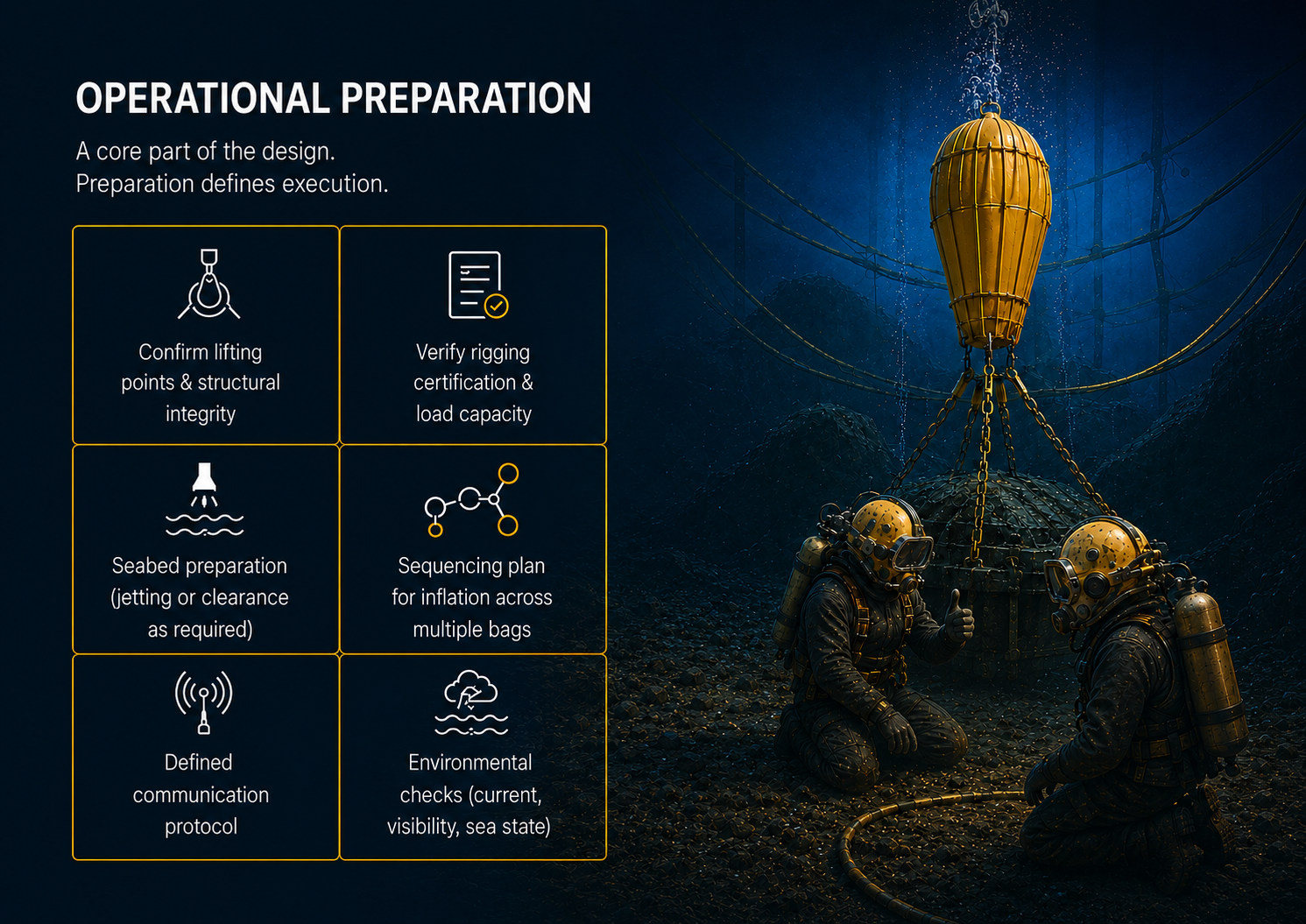
A reliable underwater lifting operation starts before mobilisation. The first step is to understand the load: estimated weight, volume, centre of gravity, structural condition, available lifting points, risk of snagging, level of embedment and sensitivity of the equipment.
The lifting plan must then reflect actual site conditions. It should define the lifting appliances, rigging arrangement, operational sequence, roles and responsibilities, communication protocol, stop criteria, exclusion zones and pre-lift checks.
On site, practical discipline is essential:
- inspect lifting points before applying load;
- confirm the orientation of the load and its immediate surroundings;
- tension the rigging progressively;
- avoid sudden break-out;
- maintain clear communication between surface and subsea teams;
- control the load path throughout the movement;
- avoid personnel working under or close to a suspended load;
- prepare contingency actions for poor visibility, excessive current or abnormal load behaviour.
Depending on the operation, lift bags, spreader beams, guide wires, tag lines, positioning aids or temporary support frames may improve load control. These tools should not be added by default. Each item must be justified by the lifting method and the risk assessment. Additional equipment without a clear function can introduce new failure points.
Safety, regulations, standards, and quality requirements
Underwater lifting involves major hazards: dropped objects, rigging failure, crushing, entrapment, loss of control, collision with existing structures, dynamic overload, diver interaction and accidental pollution.
HSE must therefore be built into the preparation phase. The risk assessment should cover normal operating conditions and degraded scenarios: stuck load, incorrect rigging, loss of communication, change in current, winch failure, vessel movement or difficulty recovering the subsea team.
Applicable requirements depend on the country, project, client and contractual framework. In an international context, IMCA guidance, DNV recommendations for marine and subsea operations and national lifting equipment regulations are commonly used as useful references. In the United Kingdom, LOLER sets expectations for proper planning, suitable equipment, adequate supervision and inspection of lifting equipment.
Quality is also a matter of traceability. Certificates for slings, shackles, hooks, spreader beams, winches and cranes must be available and consistent with the planned operation. Pre-use inspections, toolbox talks, permits to work, diving records, ROV footage, photographs and tension monitoring can all become part of the final technical file.
This documentation is not administrative decoration. It allows the client to understand what was done, how it was controlled and whether the operation remained within the agreed method.
Lessons learnt, technical tools, supervision and field control
In the field, incidents rarely come from one isolated cause. They often result from a combination of factors: incorrect weight estimate, poor lifting point selection, weak communication, underestimated current, partial seabed suction or unclear stop criteria.
The role of the supervisor is therefore critical. Supervision is not limited to checking that a procedure exists. The supervisor must read the operation in real time, identify weak signals and stop the lift if actual conditions no longer match the approved plan.
Useful tools depend on the complexity of the operation: diver inspection, ROV inspection, bathymetry, sonar, photographic survey, execution drawings, buoyancy calculations, load analysis, rigging checks and video monitoring. Their value depends on how well they are integrated into the method.
A strong field approach often means simplifying the operation. The fewer uncontrolled variables there are, the safer the lift becomes. This requires accurate preparation, clear responsibilities, direct communication and independent technical supervision when the operation is critical.
Conclusion
Underwater lifting is a technical operation that requires much more than a suitable crane or winch. It demands a clear understanding of the load, the environment, the risks, the marine spread and the interface between surface and subsea teams.
Successful execution depends on three factors: a realistic method, a competent team and continuous field control. In marine, port, offshore and subsea projects, this approach reduces uncertainty, improves safety and supports a controlled delivery.
CREOSEA supports underwater lifting operations through independent technical review, method preparation, site supervision, operational coordination and quality control, with one consistent objective: securing execution and controlling operational risk.