

Inspection and maintenance of Aids to Navigation: methods, standards and best practices.
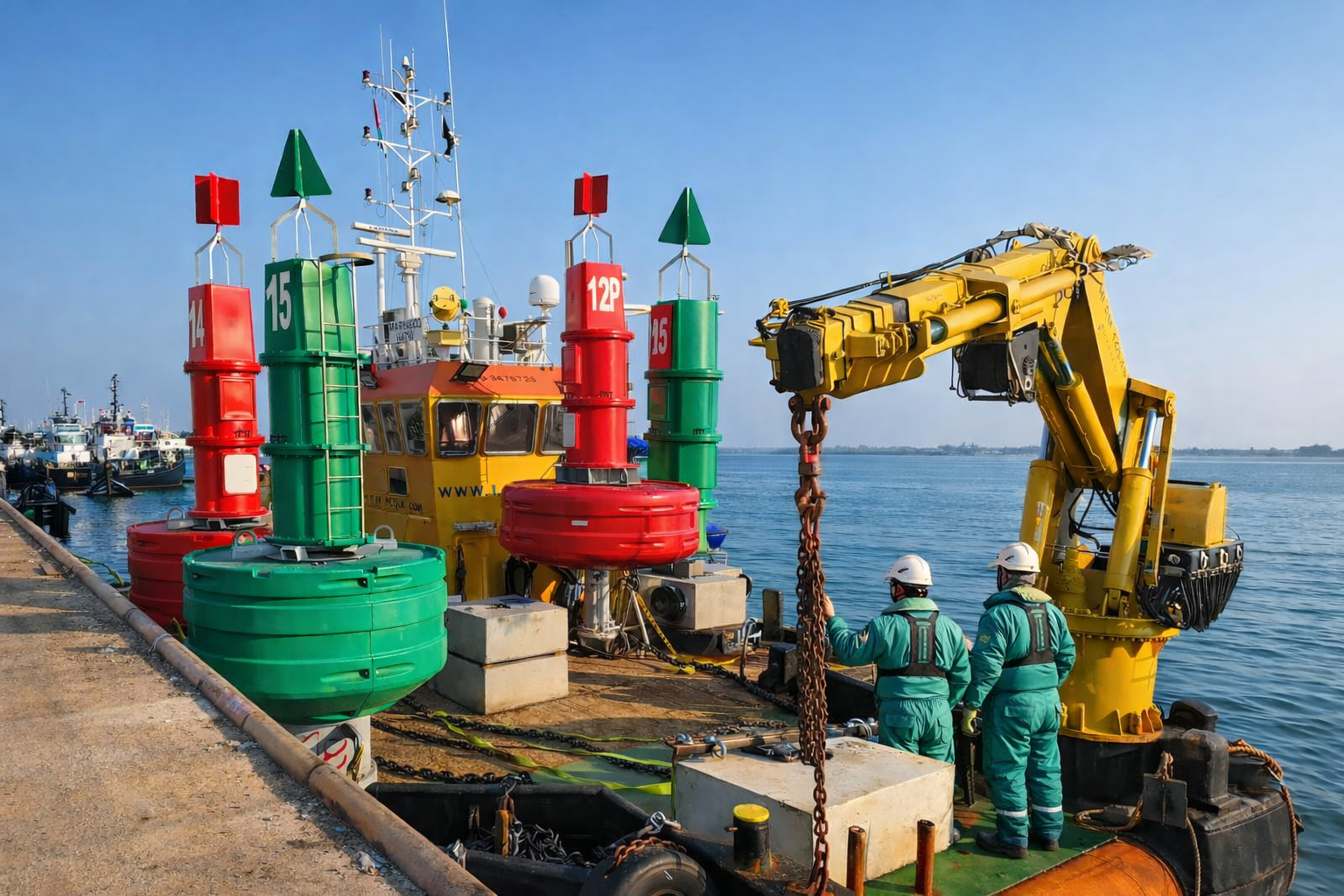
Why has the inspection and maintenance of aids to navigation become a critical issue for maritime safety?
In a context of increasing vessel traffic, stricter regulatory requirements and ageing maritime infrastructure, the reliability of Aids to Navigation (AtoN) directly conditions the safety of navigational routes and port approaches.
Buoys, beacons, lights, leading lines and AIS AtoN systems must ensure a consistent level of service under demanding operational conditions. This reliability relies on regular inspections, well-structured maintenance programmes and strict compliance with international standards.
At CREOSEA, we support port authorities, maritime administrations and engineering consultants through expert inspection and maintenance of aids to navigation, combining engineering expertise with real operational experience in the field.
Context, definition and key challenges of Aids to Navigation
An aid to navigation is any device designed to improve the safety and efficiency of maritime navigation. They are generally classified as:
- Physical AtoN: lateral and cardinal buoys, fixed beacons, lights, daymarks and leading lines.
- Electronic AtoN: AIS AtoN, racons and remote monitoring systems.
- Temporary AtoN: construction site marking, temporary channel delineation and works-related aids.
The main challenges associated with AtoN availability include:
- Vessel and crew safety.
- Continuity of port and maritime operations.
- Compliance with regulatory obligations.
- Liability exposure for operators in the event of incidents.
A malfunctioning aid to navigation represents an immediate operational and safety risk.
Inspection methodology and field best practices
Inspection of aids to navigation follows a structured and progressive methodology:
- Surface visual inspection (structural condition, corrosion, coating, markings).
- Verification of lighting systems (LED units, optics, range and synchronisation).
- Inspection of power systems (solar panels, batteries, charge regulators).
- Underwater inspection of moorings, chains, piles or gravity foundations.
Underwater inspections are carried out by professional divers or ROVs, depending on site conditions, and documented through detailed reports including photographs and videos.
Maintenance activities are organised around two complementary approaches:
- Preventive maintenance, planned and scheduled;
- Corrective maintenance, focused on identified defects or failures.
This approach ensures high availability while optimising life-cycle costs.
Safety, regulations and quality requirements
Inspection and maintenance of aids to navigation operate within a well-defined regulatory framework.
The IALA (International Association of Marine Aids to Navigation and Lighthouse Authorities) recommendations form the international reference, defining:
- Service levels and availability targets.
- Reliability and redundancy requirements.
- Principles for life-cycle management of AtoN systems.
These are complemented by:
- National and local maritime regulations.
- Port authority and operator HSE procedures.
- Specific quality requirements imposed by asset owners.
Operations in port areas or navigational channels require:
- Systematic risk assessments.
- Adapted procedures for vessel traffic and co-activity.
- Experienced technical supervision.
Operational feedback, tools and field supervision
Modern AtoN maintenance operations rely on:
- Suitable workboats and marine assets.
- Trained teams familiar with port and nearshore environments.
- Inspection and reporting tools with georeferenced data.
- Monitoring and traceability systems.
The role of the field engineer is essential:
- Defining inspection and maintenance programmes.
- Supervising offshore and port operations.
- Coordinating between operators, authorities and contractors.
- Validating technical compliance of executed works.
This integrated approach ensures full consistency between diagnosis, intervention and regulatory compliance.
Conclusion
The inspection and maintenance of aids to navigation are critical activities for maritime safety and uninterrupted port operations.
They require rigorous methodologies, proven field experience and in-depth knowledge of international standards.
CREOSEA supports its clients with a pragmatic, engineering-driven approach rooted in real maritime operations, ensuring reliable and compliant navigation aids over their entire service life.